Showing posts with label The History of Aladdin. Show all posts

Saturday, June 1, 2019

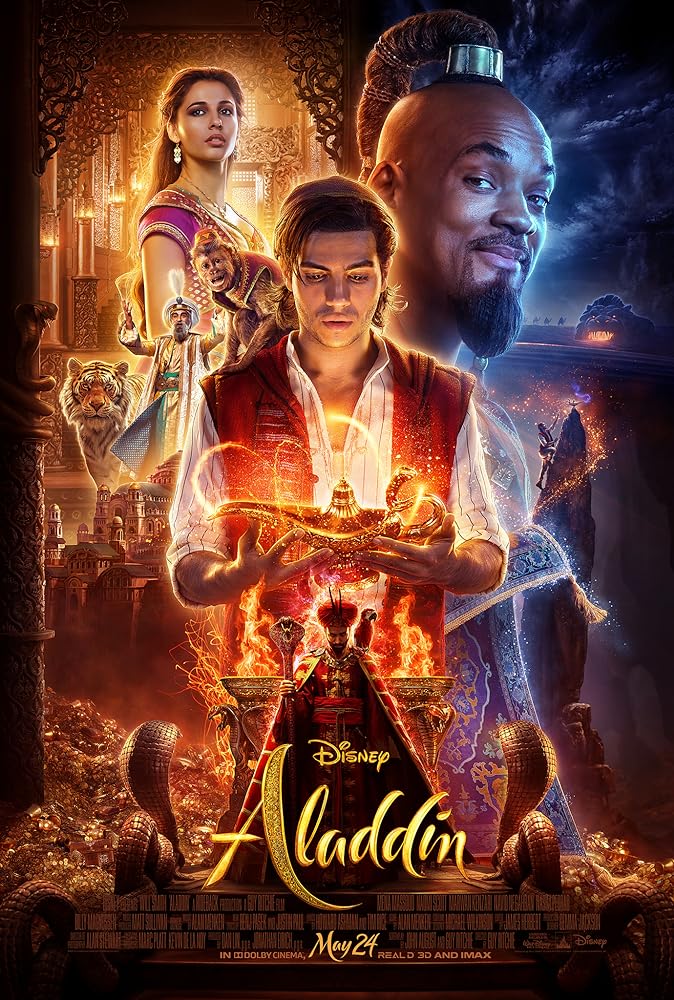
Disney's Aladdin (2019): Diamond in the Rough?

 (Source: IMDb.com)

Initially, I had mixed feelings when this remake was announced but was nonetheless excited (since this is adapting my favorite animated movie). However, this film was an example of one I should have viewed with no expectations whatsoever; I was one who hoped for deleted songs such as Proud of Your Boy, and essentially an adaptation of the stage musical using Howard Ashman's deleted lyrics. I will say if you are one who had those expectations like me, you are going to be slightly disappointed; as a minor spoiler, the only instance of deleted lyrics in the film are at the end of Arabian Nights and the new reprise of One Jump Ahead (which was surprisingly written for the original film but cut later in production, similar to the aforementioned Proud of Your Boy). Despite all this, this remake is one of Disney's best in their current trend of live-action adaptations. Admittedly, while this film is by no means perfect (nor does it hold a candle to the original and its stage musical), it still does a solid job adapting the source material while giving us something new in the process. 
Also, I am currently eating my words in regard to Will Smith's Genie and the rest of the cast (aside from Marwan Kenzari's Jafar). 
I loved the portrayals by Mena Massoud (Aladdin), Naomi Scott (Jasmine), Frank Welker (Abu, Raja, Cave of Wonders), and of course Will Smith. They did a phenomenal job portraying their respective characters in addition to fleshing them out; their renditions of the iconic songs were also beautifully done.... except for Will Smith's Prince Ali. 
While I know he was making a solid effort in that scene, the sequence as a whole lacked the energy of its animated and stage counterparts; it is disappointing because Prince Ali is my favorite song that was in the original film. I did like the part of the song where Genie was waiting for Sultan's approval to enter the palace, even though it messed up the song's flow. Harkening back to my earlier statement on deleted Ashman lyrics, I felt this song could have benefited most from using them; Genie could have used the lost intro as a means of transitioning into the main number (since the scene started rather abruptly), and the lost lyrics littered throughout the song could have been used to embellish "Prince Ali's" exploits (similar to the stage musical). Utilizing these deleted lyrics was one of main missed opportunities in this film, the other being everyone's favorite Scarlet McCaw, Iago. 
I was disappointed that Iago's role was drastically reduced from the original and stage versions, where in this version he is simply a regular parrot; he is still capable of speech, but now it is small phrases. Alan Tudyk did a great job in the role, but I wish we would have seen more from him. Aside from Abu (who remained mostly the same from the original, if not having a more expanded role), the animal characters were essentially pushed aside. 
While I am not the biggest fan of Abu, I actually enjoyed him much more in this version. He was given a more dynamic personality and was a catalyst for some events in the plot, making this little monkey one of the most enjoyable characters in the film. Additionally, he is given more time as a monkey than as an elephant, which is another bonus for the character. 
Regarding the film's events and pacing; while the story was very solid, there seemed to be somewhat of a lack of cohesion in the second and third acts, as it simply jumped from one event to another. There were plenty of moments I enjoyed (such as the scenes of Aladdin and Jasmine in the marketplace), but there were also times where it seemed like Guy Ritchie was going off a checklist, trying to hit certain points. There were moments he nailed perfectly under his direction, and there were some that could have used some work (such as the infamous "jams" running gag). 
I respect the efforts of director Guy Ritchie and the beautiful score by Alan Menken, they did a very solid job in making this film. The cast made the roles their own and did a great job, especially the main trio. Aside from Prince Ali, the entirety of Menken's score was also beautiful, and Jasmine's new song blew me away. I also loved the callbacks to the source material and the stage musical, such as making Prince Ali "of Ababwa" and the little snippet of Proud of Your Boy used at one point in the film (a moment which made me shed a few tears of joy since that is my favorite Disney song). If you go into this film with ZERO expectations, then you will have an enjoyable experience and come out satisfied. It is not exactly a "Diamond in the Rough" like one would think, but it makes a great effort in trying to be one. Aladdin is certainly worth a watch (or two or three), and I loved how it took the material of its predecessors and ran with them. However, Jafar seriously needed some work... he certainly does not hold a candle to Jonathan Freeman, not by a long shot. 

Saturday, December 16, 2017

25 Years of Aladdin! (Collaboration Between Reviews and Retrospectives and Random Antix)

In celebration of Aladdin's 25th Anniversary, my good friend Joshua Edwards and I decided to make two videos paying tribute to the film and its stage adaptation! Feel free to like, comment, subscribe, and discuss your favorite Aladdin moments!


Sunday, September 18, 2016

The History of Aladdin Part 5: So it goes short and sweet... (Finale Ultimo)

The passing of Howard Ashman had struck a heavy blow to the production teams of both Beauty and the Beast and Aladdin. However, production on the latter had to continue. It is a known fact at the Disney Animation Studio that animators and storyboard artists produce early versions of films on story reels to present to executives for critiques. Aladdin was no exception. The retrospective's finale begins with an event in the film's production history that proved to be a major turning point; Black Friday (and no I do not mean the day after Thanksgiving). John Musker and Ron Clements presented an early version of the film to Jeffrey Katzenberg, then chairman of Walt Disney Animation. After the presentation, his only response was "hey guys, that's a lotta movie! Gotta go!" and left the screening room. Taking the response as a sign of approval, the two went out for celebratory margaritas at El Toritos. However, upon returning to the studio, they were called by producer Don Ernst to his office. Ernst had some troubling news for the directors. Jeffrey's reaction to the story reel was not pleasant at all.
Ernst stated, "Jeffrey hated it! He hated everything!" The reaction was like a missile, causing a heavy blow and a major setback to the team.
They asked Katzenberg later on why if he had hated the film so much, that he did not stop the projector like he did during an early screening of The Great Mouse Detective. He replied. "I have too much respect for you guys to do that" and then followed up with "Guys, I gotta tell you, I was so disengaged that through all the movie, I was working on the guest list for my wife's surprise party!"
Clements and Musker asked Jeffrey what he did not like about the movie. Katzenberg revealed he did not like the mother character, which lead to her being cut from the story along with Proud of Your Boy later on, as they still considered having Aladdin sing the song to a deceased mother rather than one still living. Also, at the suggestion of writers Ted Elliot and Terry Rossio, the wishes were changed from unlimited to simply three, to increase the importance of each wish. Unfortunately, this lead to Humiliate the Boy being cut as well, another song Ashman had created. The project was quickly imploding and straying farther and farther away from Howard's intended vision. The mother was gone, two more songs he had written were cut, unlimited wishes became three wishes, and the score was incomplete. Iago and Jafar's personalities were also switched, with Jafar becoming the calm and collected character, and Iago becoming the short-fused, loud-mouthed parrot after seeing Gilbert Gottfried in Beverly Hills Cop II.
To complete the incomplete score, Tim Rice was brought in to work alongside Alan Menken. The first of the songs they wrote was a successor to Proud of Your Boy known as You Can Count on Me, which would later evolve into the reprise of One Jump Ahead once the song was written. Another early song idea they had written was another song for Jafar, known as Why Me. Why Me would later evolve into a reprise of the now truncated version of Prince Ali. The opening song, Arabian Nights, would also be truncated from its initial version. Friend Like Me surprisingly stayed consistent, aside from a few lyrical changes.Among the new songs written was one for the magic carpet ride sequence, which was an idea Clements and Musker suggested to Ashman during the earlier days of production. This idea would eventually evolve into what is A Whole New World in the final film. The song would also cause the film's final number to change from a reprise of Arabian Nights to a reprise of A Whole New World. Luckily, the Arabian Nights reprise would not go to waste, as it would be used to conclude not only Aladdin and the King of Thieves, but also the Aladdin franchise as well, which is fitting.
On November 8th, 1992, Aladdin finally premiered at the El Capitan Theater in Hollywood California to an overwhelmingly positive critical reception, with a general release occurring three days later on November 11th. The film was a critical and financial success, grossing over 500 million worldwide and even more in home video releases. The film was also nominated for several award nominations and won the Academy Awards for Best Original Score and Best Original Song for A Whole New World.
On home video, the lyrics were changed even further in the opening number to avoid further controversy caused by the lyric "Where they cut off your ear if they don't like your face" during its theatrical release. The lyric was changed to "Where it's flat and immense and the heat is intense" due to responses from the American-Arab Anti Discrimination Committee (ADC).However, the lyric change was not applied to the audio cassette release of the film's soundtrack, but it was later changed to the edited lyric in the Compact Disc and digital versions of the soundtrack.
Another controversy occurred between Katzenberg and Robin Williams. Williams agreed to voice the peddler and Genie in the film, on the condition of being paid SAG scale payment and his name and his character would not take up more than 25% of advertising space, along with his name not being advertised. For allegedly financial reasons, Katzenberg did not follow through with this agreement, and as such, Genie took up more space than the other main characters and was advertised as being played by Robin Williams. This dispute is why Williams did not return for the direct to video sequel The Return of Jafar and the Aladdin Television Series, and was replaced by Dan Castellaneta, best known for being the voice actor of Springfield's "village idiot" Homer Simpson from The Simpsons.
He eventually reprised his role for the aforementioned finale, Aladdin and the King of Thieves.
To conclude, Aladdin's production history was not a simple "magic carpet ride". Everyone involved went through intense trials and tribulations, such as harsh critiques from Katzenberg, song omissions and cuts, story changes, and even the loss of a valued team member. However, despite the tribulations and controversy, Aladdin went on to become a success, spanning a franchise of two sequels, a television series, and a stage adaptation that restored a majority of Howard Ashman's cut concepts and score. Speaking of Howard, I feel it would be best if he closed the book on this retrospective, since it was his film to begin with:

Tuesday, August 30, 2016

The History of Aladdin Part 4: Somber News (Finale Part 1)

(Before we begin this episode, I would like to apologize for the longer than planned hiatus. I have been moving to a new location and have been attempting to get settled in before working on this episode. I must warn all of you readers, this episode will contain mentions of some sensitive topics, so viewer discretion is advised.)

Picking up from the conclusion of the previous episode, Howard revealed a large bombshell to Ron Clements and John Musker over the phone.

Howard said over the phone, "I just want to let you know before you come out here… I’ve been ill".
Musker replied, trying to keep his composure, "how ill?"
Howard paused for a moment and then answered, "pretty ill..."

Musker's heart sank as he heard the news of Howard's illness. He asked with a hint of shakiness if they were working on a cure for his condition, or some sort of vaccine. Unfortunately, Howard replied in the negative, and told Howard to speak to his friend Nancy Parent, who knew more of the situation. Despite this, Howard was still as sharp as an X-Acto knife and was ready to get deeper into work on Aladdin.

As production began to progress even further, new developments to the music and plot were made, one of which remains in the final film in a form truncated from Howard's original idea. The former was various attempts at making a song for the villain, Jafar. One of the earlier versions was simply known as The Wazir's Song, and can be found in an early 1990 draft of the film's script. The song was to take place during the scene in which Aladdin is about to marry Princess Jasmine, but Jafar uses the power of the Genie to expose him for the "street rat" he is. The song was also used as the basis for the sequence known as Humiliate the Boy, which followed a similar series of events.

The song that made it into the finalized film (albeit in a truncated form and fully restored for the later stage adaptation) was a song to be performed after Aladdin uses his first wish to become a prince and woo the heart of Princess Jasmine, and it happens to be my favorite one that was actually in the film, a song known as Prince Ali.

Another change to come was the slow increase in age of the film's titular character. As mentioned in previous entries of the retrospective, Aladdin's age was originally around twelve years of age. However, Jasmine's age remained around sixteen since the beginning of production. To paraphrase Jeffrey Katzenberg in a scene from the documentaries A Diamond in the Rough: The Making of Aladdin and Waking Sleeping Beauty, they did not want "Julia Roberts and Michael J. Fox", they wanted "Tom Cruise and Julia Roberts". In the draft in which Prince Ali and Humiliate the Boy were both introduced, it can be speculated Aladdin's age would have been around fourteen or fifteen
.
Unfortunately, as production began to progress, Howard's health had been worsening. He revealed to Menken, Musker, and Clements in March of 1990 during the Academy Awards that he had recently discovered he was HIV (Human Immunodeficiency Virus)  positive, which would unfortunately worsen to AIDS. His movement began to become gingerly and careful, similar to a seventy year old man, and his voice began to fade from the deep voice heard in his demo recordings of songs such as Poor Unfortunate Souls, Friend Like Me, and Arabian Nights. His fading voice could be the reason why Alan Menken sings the demo of Prince Ali in The Music Behind the Magic and Howard Sings Ashman. 

(Blogger's Note: Bear with me on this next section, even I could not write this post without tearing up.)  

On March 14th of 1991 after a press presentation in New York to promote the upcoming Disney film, Beauty and the Beast (which at the time of this post being written, has recently celebrated its 25th anniversary and has a remake scheduled for release in 2017, retaining the entirety of Alan and Howard's music from 1991's original), Disney executives and people involved with promoting the film such as Alan Menken took a cab over to St. Vincent's Hospital in Manhattan to visit Howard. According to Waking Sleeping Beauty,  upon arrival, Howard pulled back his hospital bed to reveal a Beauty and the Beast sweatshirt. As Peter Schneider said in the aforementioned documentary, "he was eighty pounds, had lost his sight, and barely had a whisper of a voice. [They] shared with him what had happened that day, how amazing it was, and how Howard was there in every way. Then it was time to leave, and we had said our goodbyes. Before we left, he bent over and whispered 'Beauty and the Beast is going to be a great success. Who would have thought it, he said.' Howard lit up and whispered, 'I did.'" Howard passed away shortly afterward, and unfortunately was unable to see the completion of Beauty and the Beast and his passion project, Aladdin. Though this post is not the finale of this retrospective on Aladdin's history, it is where Howard's journey and involvement with production ends, and production would take a sharp turn in the months to come, but that is best saved for the next part which will cover the final leg of production on the film.

(To conclude this episode, I would like to say a few words to honor him for his hard work and thank him for the beautiful music he has written, as it is one of the purposes of this retrospective. I have always been a fan of his work, especially the music and lyrics he made for Little Shop of Horrors and its 1985 film adaptation, Beauty and the Beast, and of course, Aladdin. People who know me may think it was the song Proud of Your Boy which lead me to making this retrospective. It was not the song, but it was the man behind the song that inspired me to do so. Howard, if you are watching me type this from up above, this is for you. Thank you for your work, thank you for your contributions, and thank you for the inspiration. You will never be forgotten, and we have never had a friend like you!)

{In loving memory of Howard Ashman, 1950-1991}


Tuesday, August 9, 2016

The History of Aladdin Part 3: Dawn of Production!

As mentioned in the previous episode, while the executives at Disney loved reading Howard's treatment for Aladdin, it was ultimately shelved for a short period of time. The reason is unknown, whether it was due to a large amount of films in production, or due to budgeting concerns on the film. However in late 1989, Linda Woolverton was tasked with converting Howard's draft into a screenplay, and production on Aladdin began. Fortunately and unfortunately in Woolverton's initial draft of the screenplay, some significant changes were made from Howard's treatment.
To start on the list of Woolverton's changes, the sidekick characters of Babkak, Omar, and Kassim were consolidated into one aged sidekick character, (who was also a retired thief) named Abu. The film's tone was changed from being similar to a Hope/Crosby road film in which the music told the story to a film that was essentially an animated remake of The Thief of Baghdad, and unfortunately did not have any songs, having no room and no reason for Howard's. The Wazir was also named "Jaf'far" for the first time in this draft, and was similar to the villain of the same name from The Thief of Baghdad. Jasmine was also given a sidekick of her own, a handmaiden, and her personality began to change in personality from vain and spoiled to somewhat more benevolent. While Woolverton's initial draft was a solid start to what the film would ultimately become, there were many problems throughout.
The first and primary problem was the over-abundance of human characters and a lack of animal characters. The second problem was the idea to discard Howard's score and songs from the original draft. Luckily, Ron Clements and Jon Musker would rectify these problems in their version of the film as well as adding some ideas of their own.
Clements and Musker had decided to do Aladdin initially as a follow-up to The Little Mermaid, and as mentioned before, brought some changes of their own to the table, such as making the elderly Abu and the handmaiden into a monkey and tiger, respectively. They also decided to bring back what they could salvage of Howard's songs in his original treatment, as well as reviving Jafar's parrot with the new name of Iago (contrary to popular belief, the parrot was not named after the villain of Othello that was also named Iago, but he was named after the parrot in a TinTin comic). Also, Genie's character was changed from a slave portrayed by a black actor to a character that was a shapeshifter that could do impersonations of celebrities that were popular at the time.
The change in Genie's character proved to be a slight problem for Howard, as he feared the change would cause Friend Like Me to be cut from the film. Luckily, as John Musker stated in an interview with Howard Ashman's sister, "I explained to Howard that our approach to the Genie could accommodate his ability to shift into a number of personas, one of whom could be a jazzy showman". Musker stated that he believed only one man would be perfect for the role; Robin Williams. According to Howard's sister (Sarah Ashman-Gillespie) and Musker, Howard personally knew Robin, as Howard had a good friendship with his first wife while attending the same college in Vermont. While arranging to visit Howard in New York to discuss production of the film, Howard dropped a bombshell...

TO BE CONTINUED... 

Friday, August 5, 2016

The History of Aladdin Part 2: The Original 1988 Treatment

As mentioned in concluding sentences of the previous episode, while Howard and Alan were working on finishing The Little Mermaid's score and beginning preliminary work on the score of Beauty and the Beast, Howard was working on a project of his own to pitch to Disney chairman, Jeffrey Katzenberg and Roy Disney. His pitch consisted of a forty-page treatment detailing characters, preliminary song lyrics, and a plot about a young twelve year old boy with a simple motivation, to make his mother proud by any means possible. Along his journey, he is accompanied by three friends, falls for a vain and self-centered princess, and encounters two magical spirits (a spirit of a ring and a spirit of an oil lamp, the former serving as the narrator of the story), all while combating against an unnamed wazir and his parrot sidekick, Sinbad. The project he planned to pitch was an adaptation of and early version of what would be come Aladdin, based on the Arabian Nights tale of the same name. While Howard's initial draft of the film would contain a few similarities and similar elements to the film released in 1992, his initial draft was significantly different in terms of plot, characters, and the musical score.
The first set of these major differences from the initial draft lies in the film's title character, Aladdin. Unlike the final film in which Aladdin is an adult voiced by Scott "Steve from Full House" Weinger accompanied by a monkey voiced by Frank Welker, Aladdin in the initial treatment was a twelve year old boy with three human friends named Babkak, Omar, and Kassim, along with another lost character named Abbi/Abby (whom unfortunately was not restored for the stage adaptation). Also unlike the final film in which Aladdin was orphaned by his adulthood, Aladdin's mother is still alive in the original draft and is the main source of motivation. The original Aladdin, unlike his finalized counterpart, did not only want a better life for himself, he wanted to make his mother proud and atone for his thieving ways. While this portion of the original motivation did not make it into the final film, it was thankfully restored for the stage adaptation, along with a song that better explains this goal (and it happens to be my favorite Disney song of all time), Proud of Your Boy, which will be discussed in further detail later on when the plot elements are compared between final film and draft.
The second set of major differences lie in the characters of Princess Jasmine, and the wazir and parrot that would later on become Jafar and Iago, respectively. Jasmine was originally not the benevolent and kindhearted princess that she was in the final film. Matter of fact, she was a bit of a "spoiled brat" and did not begin to change and develop until after she met Aladdin in the guise of a prince, better known as "Prince Ali" in the final film. According to Lost MediaWiki's article on the initial treatment, the initial version of Jasmine was "a purely comic creation; the ultimate in pampered spoiled brattiness". She would not be the only character living in the palace to have significant character changes, as the characters that would become Jafar and Iago in later drafts also were different from their final counterparts.
To start, Jafar's initial version was nameless; simply referred to in the treatment as "The Wazir". Like in the final film, he was a combination of the royal vizier, the vizier's son, and the magician from the original Arabian Nights story. However, his personality and temperament were similar to the finalized version of his parrot sidekick, known as Sinbad in the original treatment (a reference to the stories of Sinbad the Sailor in the Arabian Nights). Like how The Wazir's personality was similar to the final version of Sinbad (later named Iago), Sinbad's initial personality was similar to the final version of The Wazir (later given the name of Jafar as production progressed). Despite their personalities being switched, their motivation and goals were essentially the same, retrieval of the magic lamp and become ruler of Baghdad (later named Agrabah). Unfortunately, not much is known about the original version of Jasmine's father, the Sultan, aside from the fact of him being called "Sultan Hamed" in the initial draft (the first name of the sultan was later restored for the stage adaptation of the film). Before moving on to the differences in plot and score, there is one more character that needs to be covered, and a mention of a similar character that was cut from the film.
If those reading this have seen the stage adaptation of the movie and wondered, "the guy playing Genie is nothing like how the late Robin Williams or Dan "Homer Simpson" Castellaneta portrayed him", then you would be surprised to hear this fact; James Monroe Iglehart's version of Genie is portrayed more similarly to Howard's original concept of the character rather than the portrayal by Robin Williams. Originally, Genie was inspired by jazz musicians such as Cab Calloway and Fats Waller, and granted unlimited wishes to Aladdin and The Wazir instead of three wishes like in the final film. There was also a Genie of the Ring, who served as the first incarnation of what would later become the peddler in the final film, appearing at points in the story to provide commentary through song, one of the various plot differences from the film we all know.
Compared to what was ultimately released to the movie-going audience, the plot and score not only have significant differences between the two, the two versions of the film almost feel like entirely different movies with similar scenes and songs. According to John Musker, the film's setting was a "Hollywood-ized Baghdad" in which a young Aladdin and his friends, Babkak, Omar, Kassim, and Abby would roam. Currently, it is unknown if Aladdin still stole for him and his mother to survive, but if that was the case like in the final film, it was also because Aladdin refused to work (as evidenced in the song Babkak, Omar, Aladdin, Kassim, a prototype of the final film's One Jump Ahead).
Like in the finalized version, the opening number was Arabian Nights, albeit with significant differences in length, lyrics and what character is singing the song. Also unlike the released film, Arabian Nights had four reprises throughout the story, in which the Genie of the Ring would appear and either introduce a character (which was the reason for Reprise one), provide commentary on a situation (Reprises two and three), or serve as an early version of the finale (Reprise four, which finally saw the light of day when it served as the closing number for not only Aladdin and the King of Thieves, but the entirety of the Aladdin saga, as well as being restored in its proper position for the stage adaptation). After Aladdin and his friends are introduced as well as the theorized early version of the "One Jump", we are treated to the first reprise of Arabian Nights, which introduces The Wazir, The Sultan, Sinbad the Parrot, and Princess Jasmine. Succeeding the reprise was originally going to be a song named Call Me a Princess, but the song was cut before Howard finished the treatment, as it proved to be unpopular with himself and Alan (and those who saw the initial versions of the stage musical before Broadway, though I found it interesting as it shows how far Jasmine has evolved as a character).
When cutting back to Aladdin, we are introduced to his "uncle", which is actually The Wazir in disguise, leading in to Arabian Nights Reprise Two, sung as Aladdin and his "uncle" are searching for both The Cave of Wonders as well as the magic lamp inside of it, and Aladdin is presumably given a magic ring with a Genie inside, a nod to the original story that inspired the film. Like in the final film, Aladdin would somehow be trapped in the cave and forced to release Genie from the lamp. The release of Genie would lead into a jazzier and somewhat sinister early version of the popular Friend Like Me. After Aladdin returns home to his friends and his mother, it is here where Aladdin's motivations are revealed through the beautiful song, Proud of Your Boy. Unfortunately, as Aladdin plans to win the heart of Princess Jasmine by masquerading as a prince, he begins to grow cold and distant towards his friends, presumably leading into the song How Quick They Forget, where Babkak, Omar, and Kassim lament on losing the friendship of Aladdin to the princess. However, friendships would presumably be regained either before or after the third reprise of Arabian Nights, which showed either Aladdin or Jasmine being imprisoned, and served as a lead-in to High Adventure in which Aladdin enlists the assistance of Babkak, Omar, Kassim, and The Genie of the Ring (I guess he did have some role in the story aside from narrating, but like the rest of the original plot, the extent of his role is mostly unknown). On his adventure to save Jasmine, he begins to realize his feelings for Abby as well as the feelings she reciprocated for him, and ultimately chooses her instead of Jasmine upon saving the city of Baghdad. The Wazir's fate in the initial treatment is unfortunately unknown.
Unfortunately, though Roy Disney and the higher-ups at Disney enjoyed Ashman's treatment, it was unfortunately passed on and shelved. Howard had considered getting the rights back and creating the film independently without Disney's involvement, but ultimately decided not to follow through with the plan and the treatment remained in the Disney archives.
If one wishes to view the original treatment, a copy is available for viewing at The Library of Congress as part of a series of works known as The Howard Ashman Papers, and another copy presumably exists in the Disney Animation Research Library. In the next episode, we will jump forward to late 1989-early 1990, when production on Aladdin resumed, and detailing the trials and tribulations rose throughout.

Special Thanks/Sources:

Mrs. Sarah Ashman-Gillepsie (sister of the late Howard Ashman) for taking the time to answer my questions about Howard's early years at Disney and giving her blessing on pursuing this ambitious project

 "Aladdin (Howard Ashman Original Treatment)." Lost Media Wiki. N.p., n.d. Web. <http://lostmediawiki.com/Aladdin_(Howard_Ashman's_original_film_treatment;_1988)>. 

 Ashman, Sarah, and John Musker. "Da Doo Blog: John Musker Question Countdown #9." Da Doo Blog Part of His World Sarah Ashman Gillespie. N.p., 21 Feb. 2012. Web. 06 Aug. 2016. <http://howardashman.com/blog/john-musker-question-countdown-number-9/>. 

 Ashman, Howard, Alan Menken, Marvin Hamlisch, Alan Menken, and Marvin Hamlisch. Howard Sings Ashman. PS Classics, 2008. MP3. 

 Menken, Alan, Howard Ashman, and Tim Rice. The Music Behind the Magic. Walt Disney Records, 1994. CD. Discs 3 and 4

 Aladdin. Dir. John Musker and Ron Clements. Prod. John Musker and Ron Clements. By John Musker, Ron Clements, Alan Menken, Howard Ashman, Tim Rice, Scott Weinger, Robin Williams, and Linda Larkin. Buena Vista Pictures Distribution, Inc., 1992. DVD.


Thursday, July 21, 2016

The History of Aladdin Part 1: Howard Ashman's Early Disney Days (1985-1988)

In the premiere episode of The History of Aladdin, we are going to go back in time to the year 1986, the year composer-lyricist duo Alan Menken and Howard Ashman were hired by The Walt Disney Company to compose songs for upcoming films such as Oliver and Company and The Little Mermaid, hot off the heels of the success of the 1982 off-Broadway musical adaptation of the Roger Corman film, Little Shop of Horrors as well as the success of the musical Smile, which would later receive a film adaptation in 1986 starring Rick Moranis, Ellen Greene, and Levi Stubbs (writer's note: the film adaptation is a personal favorite).

(Little Shop of Horrors, 1982 Act 1 Audio-Only)

Howard worked with Disney with a simple goal in his mind, to bring the company and the films they created back to their roots, letting the music tell the story in conjunction with the animation onscreen similar to how it was done in films such as Pinocchio, Mary Poppins, and The Jungle Book. However, before he was signed on to compose The Little Mermaid, he was tasked with composing the opening song for Oliver and Company, Once Upon a Time in Central Park.

 (Once Upon a Time in Central Park, Howard Ashman and Huey Lewis)

While working on the song, he was informed of another project which his frequent collaborator Alan Menken would also be involved in, an adaptation of Hans Christian Andersen's The Little Mermaid, a project Disney himself attempted when he was alive but shelved due to story complications. Howard and Alan began to work on a score of songs, with now classic songs such as Under the Sea and Part of Your World. Speaking of the latter, according to the documentary Waking Sleeping Beauty, Part of Your World was nearly cut from the final film due to lack of audience engagement during test screenings of the film. Had it not been for Howard intervening and literally giving threats to former President of Disney Jeffrey Katzenberg to keep the song in the final film, Part of Your World would have probably ended up in the deleted scenes section on disc two of The Little Mermaid.

 
(Source: Waking Sleeping Beauty, Howard Ashman and Jodi Benson, Part of Your World)
 
Another of Howard's contributions to the film was in the character Sebastian. Originally, Sebastian's character was supposed to be a stuffy, stereotypical English butler type of character, but Howard suggested "Why not make him Jamaican?" which also gave birth to the Disney classic, Under the Sea, a Jamaican-Calypso style song used for the "showstopper" song in the film.

 (Under the Sea, Howard Ashman Demo)

 To critique the score of the film, while not being a huge fan of The Little Mermaid myself, I do admit the entirety of the demo score is filled with Howard's energy and passion that he personally injected, from the original extended demo of the opening number Fathoms Below to the original demo of the film's finale. Howard also wrote at least two songs that while they did not make it into the final film, they served as prototypes of songs that did. These songs were One Dance and Silence is Golden, prototypes of Part of Your World and Poor Unfortunate Souls, respectively. 

  
(Silence is Golden, The Music Behind the Magic, Walt Disney Records)

 
(One Dance, Walt Disney Records)

 However, while he was ecstatic and passionate about his work on Mermaid as well as beginning work on the film to be released afterward, Beauty and the Beast, he was preparing to pitch a project he had wanted to do since he began work at Disney, an adaptation of the Arabian Nights story, Aladdin. In the next episode, we will journey to the early days of the film's production with a look at the original forty page treatment written by Ashman himself.

Sources:

Gillespie, Sarah. "John Musker Countdown Question 9." Part of His World. Sarah Ashman-Gillespie, 21 Feb. 2012. Web. <http://howardashman.com/>. 

Waking Sleeping Beauty. Dir. Don Hahn. Perf. John Musker, Ron Clements, Roy Disney, Christopher Emerson. Walt Disney Studios, 2009. Amazon Instant Video. Documentary detailing the events of the first half of what is known as The Disney Renaissance, and the constant conflicts with Jeffrey Katzenberg.
Note: Videos were taken from YouTube from various sources as supplementary material, if you are the original owner of these videos and you request I take them down, feel free to message me at austinmmyers@yahoo.com 


Thursday, July 14, 2016

The History of Aladdin Introduction

I have been waiting for such a long time to do this series of posts. However, I felt that I would not be doing justice to this topic if I did not do extensive research beforehand, as this pertains to my favorite animated film and its history as it faced multiple trials and tribulations throughout from its earliest draft in 1988 to the Broadway musical released in 2014. Of course, I am talking about the classic Disney film, Aladdin. Before we begin this magic carpet ride through Disney history, I would like to give thanks to the sources of my information and thank those who have helped me research this topic, such as the creator of the Aladdin Musical Blog as well as the site, The Lost Media Wiki, The Howard Ashman Website, and the two documentaries Waking Sleeping Beauty and A Diamond in the Rough: The Making of Aladdin as well as my two friends who have helped me with the research for the past three years. In this weekly retrospective starting next Thursday, I will be going over the complete history of Aladdin and dividing it into eras, such as the era of Howard Ashman's original treatment, the Menken-Ashman era, Black Friday and its effects on the film's production, the Menken-Rice Era, the release of the 1992 film, and conclude the retrospective with the history of the stage adaptation now playing on Broadway as well as how the film has impacted and inspired me throughout my life. If this series is successful, I may do a series of retrospectives on other Disney animated films such as Beauty and the Beast, The Lion King, and The Hunchback of Notre Dame.